.jpeg)
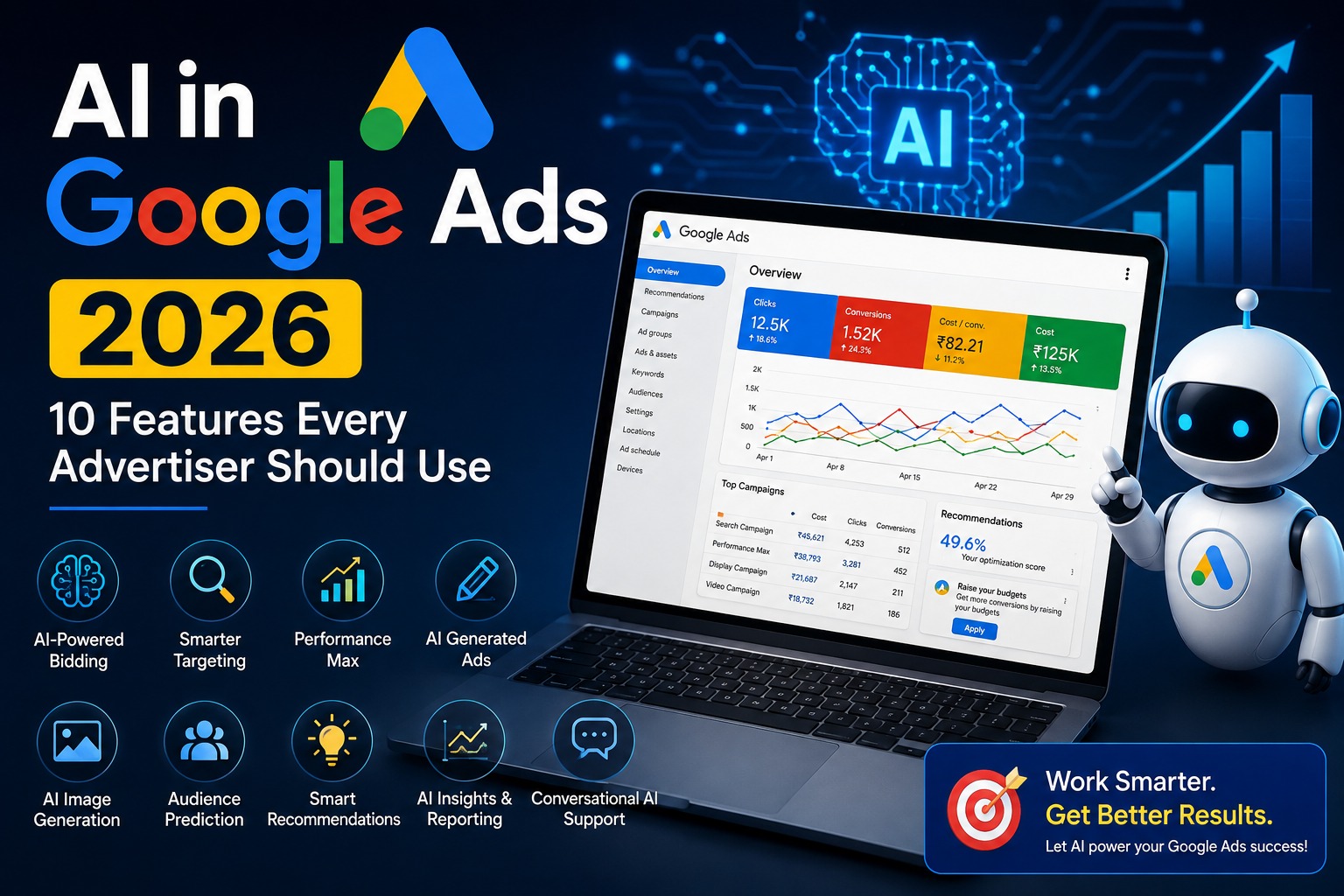
AI in Google Ads: 10 New Features Every Advertiser Must Use in 2026
Artificial Intelligence (AI) has completely transformed Google Ads. Managing campaigns manually is no longer enough to stay competitive. Google now uses machine learning to optimize bids, generate ad creatives, predict customer behavior, and improve conversions automatically.
If you're still using Google Ads the same way you did a few years ago, you're missing powerful features that can help you get better results with less effort.
In this guide, we'll explore the latest AI features in Google Ads that every business owner and marketer should start using in 2026.
Why AI Is Changing Google Ads
Google processes billions of searches every day. AI helps analyze this massive amount of data to determine
- Which users are most likely to convert
- The best bid for every auction
- Which ad copy performs better
- Which audience has higher purchase intent
How to maximize conversions while staying within your budget
Instead of relying only on manual optimization, AI continuously learns and improves campaign performance.
1. AI Max for Search Campaigns
Google's AI can now expand search intent beyond exact keyword matching. It understands what users mean instead of matching only specific words.
- Benefits
- More qualified traffic
- Better keyword coverage
- Higher conversion opportunities
- Less manual keyword management
2. Smarter Smart Bidding
Smart Bidding has become much more accurate.
It now analyzes signals such as
- Device
- Location
- Time of day
- User intent
- Previous browsing behavior
- Search history
Demographics
AI adjusts bids automatically for every auction.
Popular bidding strategies include
- Maximize Conversions
- Target CPA
- Target ROAS
- Maximize Conversion Value
3. AI-Powered Performance Max Campaigns
Performance Max has become Google's flagship campaign type.
Instead of managing separate campaigns for
- Search
- Display
- YouTube
- Gmail
- Discover
Maps
Performance Max uses AI to decide where your ads should appear for the best results.
Businesses using quality assets and conversion tracking often see improved performance compared to manually managed campaigns.
4. Automatically Generated Headlines and Descriptions
Google Ads now suggests high-performing headlines and descriptions using AI.
It analyzes
- Your landing page
- Existing ads
- Business information
Search intent
This helps advertisers create stronger Responsive Search Ads faster.
5. AI Image Generation
One of the biggest improvements is AI-generated creative assets.
Businesses can generate
- Product images
- Lifestyle backgrounds
- Marketing visuals
Display banner ideas
This reduces design costs and speeds up campaign creation.
6. Better Audience Prediction
AI identifies users who are most likely to
- Buy
- Fill out a form
- Call your business
Visit your store
Instead of relying only on manual audience selection, Google continuously improves targeting based on conversion data.
7. AI Recommendations
Inside Google Ads, you'll find AI-generated recommendations such as
- Add new keywords
- Increase budget
- Improve ad strength
- Fix conversion tracking
- Remove duplicate keywords
Improve Quality Score
Always review recommendations before applying them. Not every suggestion is suitable for every business.
8. Improved Conversion Tracking
AI depends on accurate conversion data.
Google now models conversions even when some user data isn't available because of privacy restrictions.
This helps advertisers make smarter bidding decisions while respecting user privacy.
9. AI Insights Dashboard
Google Ads now provides AI-generated insights, including
- Why conversions increased
- Why costs changed
- Search trends
- Seasonal demand
- Competitor movement
Performance opportunities
These insights help advertisers make faster, data-driven decisions.
10. Conversational AI for Campaign Creation
Google Ads now offers conversational assistance when creating campaigns.
Instead of filling every field manually, advertisers can describe their business, goals, and target audience. AI then suggests campaign settings, keywords, ad copy, and creative ideas.
This makes campaign setup much faster, especially for small businesses and beginners.
Best Practices for Using AI in Google Ads
AI works best when you provide high-quality inputs. Follow these best practices
Set up accurate conversion tracking.
Use clear campaign goals.
Add multiple headlines and descriptions.
Upload high-quality images and videos.
Review AI recommendations instead of applying them blindly.
Monitor performance regularly and make adjustments when needed.
Common Mistakes to Avoid
Many advertisers expect AI to deliver great results without proper setup. Avoid these mistakes
Launching campaigns without conversion tracking.
Using weak landing pages.
Setting unrealistic budgets.
Making major changes every day before AI has time to learn.
Ignoring search terms and campaign reports.
The Future of Google Ads
AI will continue to play a bigger role in advertising. Future updates are expected to include
More advanced creative generation.
Better predictive bidding.
Deeper audience insights.
Improved automation across campaign management.
Faster optimization based on real-time user behavior.
Businesses that embrace AI early will be better positioned to improve campaign performance and stay competitive.
Final Thoughts
Artificial Intelligence is no longer an optional feature in Google Ads—it's now a core part of how campaigns are created, optimized, and scaled.
By understanding and using these AI-powered features, businesses can save time, improve campaign efficiency, and increase conversions. While automation is powerful, successful campaigns still require clear goals, strong creative assets, accurate tracking, and regular human oversight.
If you're running Google Ads in 2026, combining AI with strategic decision-making will help you get the best results.
Frequently Asked Questions
Is AI replacing Google Ads experts?
No. AI automates many tasks, but experienced marketers are still needed to plan strategy, optimize landing pages, analyze results, and make business decisions.
Which Google Ads campaign benefits the most from AI?
Performance Max campaigns make extensive use of AI to optimize placements, bidding, and audience targeting across Google's advertising channels.
Is AI in Google Ads free?
Yes. AI-powered features are included within Google Ads, and you pay only for your advertising spend according to your campaign settings.
Can small businesses benefit from AI in Google Ads?
Absolutely. AI helps small businesses automate bidding, improve targeting, and optimize campaigns without requiring a large marketing team.

Yash Deliwala
Google Ads Freelancer and PPC Consultant based in India. Specializing in high-intent Search campaigns, Performance Max, lead generation, and conversion tracking for businesses across India.
Want to Scale Your Business with Google Ads?
Get direct campaign planning, Search ad setup, and lead optimization with Yash Deliwala.
Chat with Yash on WhatsApp