.jpeg)
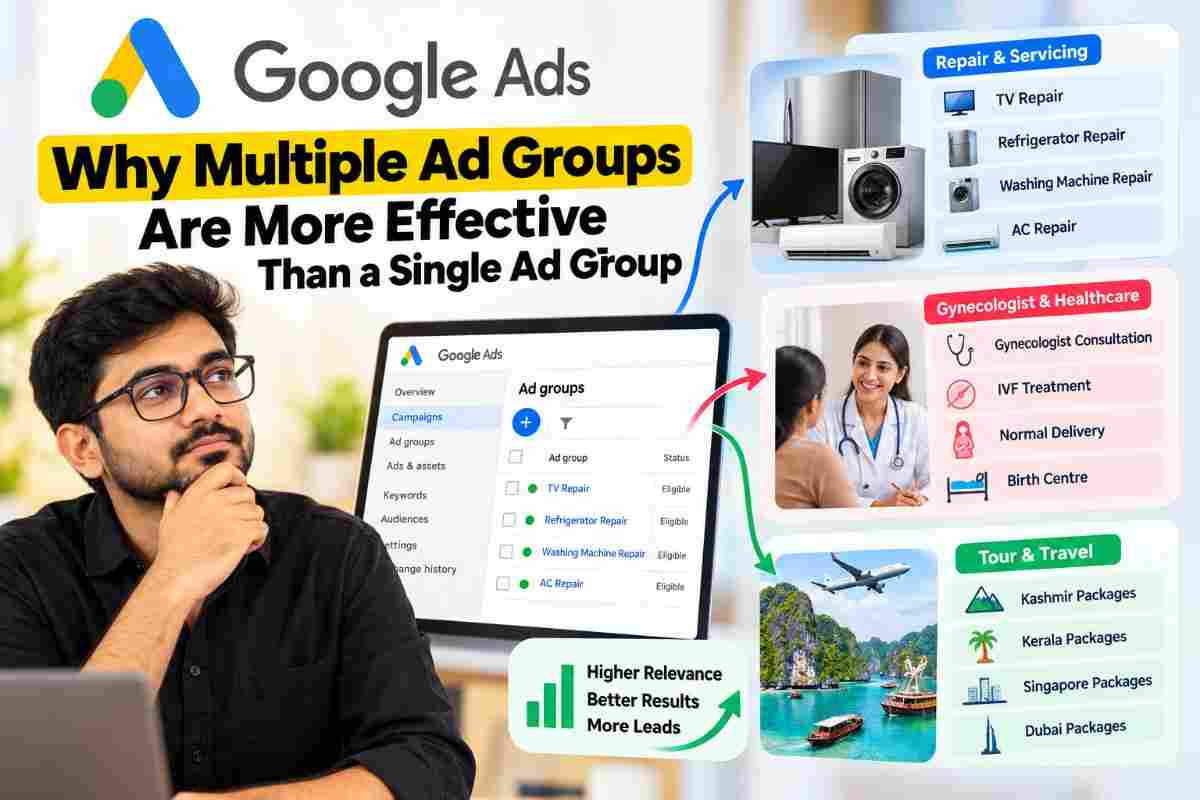
# Why Multiple Ad Groups in Google Ads Can Improve Your Campaign Performance
Introduction
Running Google Ads is not just about selecting keywords and setting a daily budget. The way you organize your keywords, ads, and landing pages can make a significant difference to your campaign performance.
One common mistake advertisers make is putting every keyword related to their business into a single ad group. Although this approach may look simple, it can make it difficult to show highly relevant ads to people searching for different services.
A well-structured campaign organizes related keywords into relevant ad groups, with ads and landing pages that match the user's search intent.
Let's understand why this matters and how businesses can benefit from this strategy.
1. What Is an Ad Group in Google Ads?
An ad group is a collection of related keywords, ads, and associated targeting settings within a campaign.
For example, a home appliance repair business might offer
- TV repair
- Refrigerator repair
- Washing machine repair
- Air conditioner repair
Instead of combining all these services into one ad group, the advertiser can create separate ad groups for each service.
This allows the business to write more specific ads and direct customers to the most relevant service page.
2. The Problem With Using Only One Ad Group
Imagine that a customer searches for "LED TV repair near me."
If your ad group contains keywords for TV repair, refrigerator repair, washing machine repair, and AC repair, you may struggle to make every ad equally relevant to each search.
You might end up showing a generic ad such as
"Best Home Appliance Repair Services – Call Today!"
The ad communicates your overall service, but it does not specifically address the customer's need for TV repair.
Now imagine another customer searching for refrigerator repair. The same generic ad may not communicate your refrigerator servicing expertise clearly either.
A single ad group is not always wrong, especially for a small campaign with closely related keywords. However, combining services with different search intent can reduce your ability to customize ads and landing pages.
3. How Multiple Ad Groups Help
A. More Relevant Ads
When you organize keywords by service, you can create ads that directly address what customers are searching for.
For example
- **TV Repair Ad Group**
- LED TV Repair
- TV Repair Service
- TV Technician Near Me
- Example headline: "LED TV Repair Service – Book a Technician"
- **Refrigerator Repair Ad Group**
- Refrigerator Repair
- Fridge Repair Service
- Refrigerator Technician Near Me
Example headline: "Fridge Repair at Your Home – Call Today"
Each ad can communicate the relevant service instead of presenting a generic business message.
B. Better Landing Page Relevance
Your landing page should match the service advertised.
For example
- TV repair ad → TV repair landing page
- Refrigerator repair ad → Refrigerator repair landing page
- Washing machine repair ad → Washing machine repair landing page
When a user clicks an ad for refrigerator repair, they should not have to search through a general website to find refrigerator servicing details.
A relevant landing page makes it easier to understand the service, review the benefits, and contact the business.
C. Better Control Over Keywords and Search Intent
Separate ad groups make it easier to review search terms, identify irrelevant queries, add negative keywords where appropriate, and refine keyword targeting.
For example, someone searching for "TV repair course" may be looking for training rather than a repair technician. Reviewing search terms helps you identify such mismatches and reduce wasted spend.
D. Easier Performance Analysis
With a sensible structure, you can evaluate which services generate clicks, leads, and conversions.
You may discover that TV repair generates more qualified enquiries, while refrigerator repair generates fewer but more valuable jobs.
This information can help you make informed decisions about budgets, ads, and service priorities. Remember that separate ad groups do not automatically guarantee better results; performance still depends on targeting, competition, budget, landing pages, and conversion tracking.
4. Real-World Example: Gynecologist and Women's Healthcare Clinic
Consider a clinic offering several different services
- Gynecologist consultations
- IVF consultations
- Pregnancy care
- Normal delivery services
- Maternity and birth centre services
Each service may attract users with a different need.
A possible structure could be
**Ad Group 1: Gynecologist**
Target relevant searches for gynecologist consultations and appointments.
Landing page: Gynecologist consultation page.
**Ad Group 2: IVF Treatment**
Target relevant searches for IVF consultations and fertility treatment.
Landing page: IVF services page.
**Ad Group 3: Normal Delivery**
Target relevant searches for normal delivery services and maternity care.
Landing page: Maternity and delivery services page.
**Ad Group 4: Birth Centre**
Target relevant searches related to the clinic's birth centre facilities and services.
Landing page: Birth centre page.
This structure lets the clinic communicate the correct service to each audience instead of using one generic advertisement for every healthcare search.
5. Real-World Example: Tour and Travel Business
A travel agency offering domestic and international holiday packages can also benefit from service-specific ad groups.
For example
**Ad Group 1: Kashmir Tour Packages**
Keywords could include Kashmir holiday packages, Kashmir family tour packages, and Kashmir travel packages.
Landing page: Kashmir packages with itinerary, inclusions, pricing, and enquiry options.
**Ad Group 2: Kerala Tour Packages**
Keywords could include Kerala holiday packages, Kerala family tours, and Kerala honeymoon packages.
Landing page: Kerala packages with relevant destinations and itineraries.
**Ad Group 3: Singapore Tour Packages**
Keywords could include Singapore tour packages, Singapore family packages, and Singapore holiday deals.
Landing page: Singapore packages with trip details, inclusions, and pricing.
A person searching for a Kashmir package is likely to expect information about Kashmir, not a generic page displaying every destination the business offers.
Matching the ad and landing page to the destination helps create a more relevant customer journey.
6. Does Creating More Ad Groups Automatically Improve Quality Score?
No. Creating additional ad groups does not automatically improve Quality Score or lower your cost per click.
Google evaluates several factors, including expected click-through rate, ad relevance, and landing page experience.
The purpose of a well-organized account is to make it easier to align keywords, ads, and landing pages with user intent. This can support stronger campaign performance, but the actual results must be measured.
Avoid creating separate ad groups merely to increase their number. Group keywords when there is a meaningful difference in search intent, messaging, or the landing page required.
7. When Should You Create Separate Ad Groups?
Consider separate ad groups when
- Your business offers distinct services.
- Customers use meaningfully different search terms for each service.
- Different services require different ad copy.
- You have relevant landing pages for individual services.
- You need to analyze performance by service.
- Search intent differs enough that one set of ads would not serve all keywords effectively.
If several keywords share the same intent and can use the same ads and landing page, keeping them together may be more efficient.
Conclusion
A successful Google Ads campaign is not simply about adding more keywords. It is about connecting the right search, the right advertisement, and the right landing page.
Whether you run a repair business, healthcare clinic, or travel company, organize your ad groups around meaningful differences in customer intent.
Start with a clear structure, track qualified leads, review search terms, and optimize based on actual results.
**Need help structuring your Google Ads campaign?** Visit Yash Deliwala's website to learn more about Google Ads management and lead generation services.

Yash Deliwala
Google Ads Freelancer and PPC Consultant based in India. Specializing in high-intent Search campaigns, Performance Max, lead generation, and conversion tracking for businesses across India.
Want to Scale Your Business with Google Ads?
Get direct campaign planning, Search ad setup, and lead optimization with Yash Deliwala.
Chat with Yash on WhatsApp